
Recall
Tools for Possibilities: issue no. 192
Memorable estimates
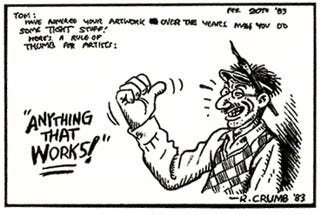
I’m a big fan of rules of thumb. Like: “Count the number of times a cricket chirps in 15 seconds, and add 37. That’s the temperature in Fahrenheit.” They are great estimating tools. At the Whole Earth Catalog we first published Tom Parker’s collection of these portable estimates, soliciting others from readers. I suggested a few rules of my own, which made their way into one of Parker’s later books. Since I remember — and use — a number of these rough recipes, I have always regretted that the books were out of print. If ever there was knowledge ideal for the web, rules of thumb are it. Tom Parker has recently digitized all the rules he has collected. He posts one old rule per day, and one new one suggested by readers. As the rules are tagged over time to make searching easier, we’ll finally have the world-wide database of guesstimates that short-cut-takers like myself have always wanted.
You can find inexpensive used copies of the books, Rules of Thumb, and Rules of Thumb 2, but the web site really is a much better way to use and discover these. Parker has refined his explanation of what rules of thumb are, and why they are cool tools. He writes:
“A rule of thumb is a homemade recipe for making a guess. It is an easy-to-remember guide that falls somewhere between a mathematical formula and a shot in the dark. Rules of thumb are a kind of tool. They help you appraise a problem or situation. They make it easier to consider the subtleties of the topic at hand; they give you a feel for a subject. A rule of thumb is not a joke or a ditty. It is not a Murphy’s Law. Murphy says that things will take longer than we think; a rule of thumb says how much longer. While a proverb says that a stitch in time saves nine, a rule of thumb says to allow one inch of yarn for every stitch on a knitting needle.”
I’ve spent a lot of time reading through these over the years. I now subscribe to the Rules of Thumb RSS feed from Parker’s site. My new rule of thumb: “One in 25 rules of thumb will be useful to you.” YMMV, but I find that a pretty good hit rate. — KK
The best way to make money in residential real estate is to buy the worst home on the best street.
The moon covers half a degree of sky.
When digging a grave by hand, haul away 17 wheelbarrow loads of dirt and pile the rest by the hole. You will have just the right amount to backfill.
For marketing purposes, elderly consumers think they are 15 years younger than they actually are.
The price of a telescope increases proportionately to the cube of the lens diameter.
Recovering an unused physical skill takes one month for each year of layoff.
If you walk into a bar where a lot of people wear baseball caps, it’s a good place to sell lottery tickets.
Eclipses often come in pairs. A lunar eclipse is followed frequently by a solar eclipse two weeks later, and vice versa.
If the cats aren’t sleeping on the radiators, turn down the heat.
One chemical toilet serves 15 employees per week.
It takes two minutes for the sun to drop out of sight once it touches the horizon.
If a woman can walk around during contractions, she is not fully dilated.
When you are working in the vicinity of high voltage, keep 1 foot of distance between you and the power source for each 1,000 volts. For instance, stay 13 feet away from a 13,000 volt power source.
You have a 50 percent chance of surviving overboard in 50 degree water for 50 minutes.
Spring moves up in altitude 1000 feet per week
Ten people will raise the temperature of a room one degree per hour
If a speech takes 15 minutes in a dry run, it will take one third longer on the actual event.
Rental property should sell for 100 times the monthly rental income.
Double the height of a 3-yearold to determine his or her adult height.
How to memorize anything
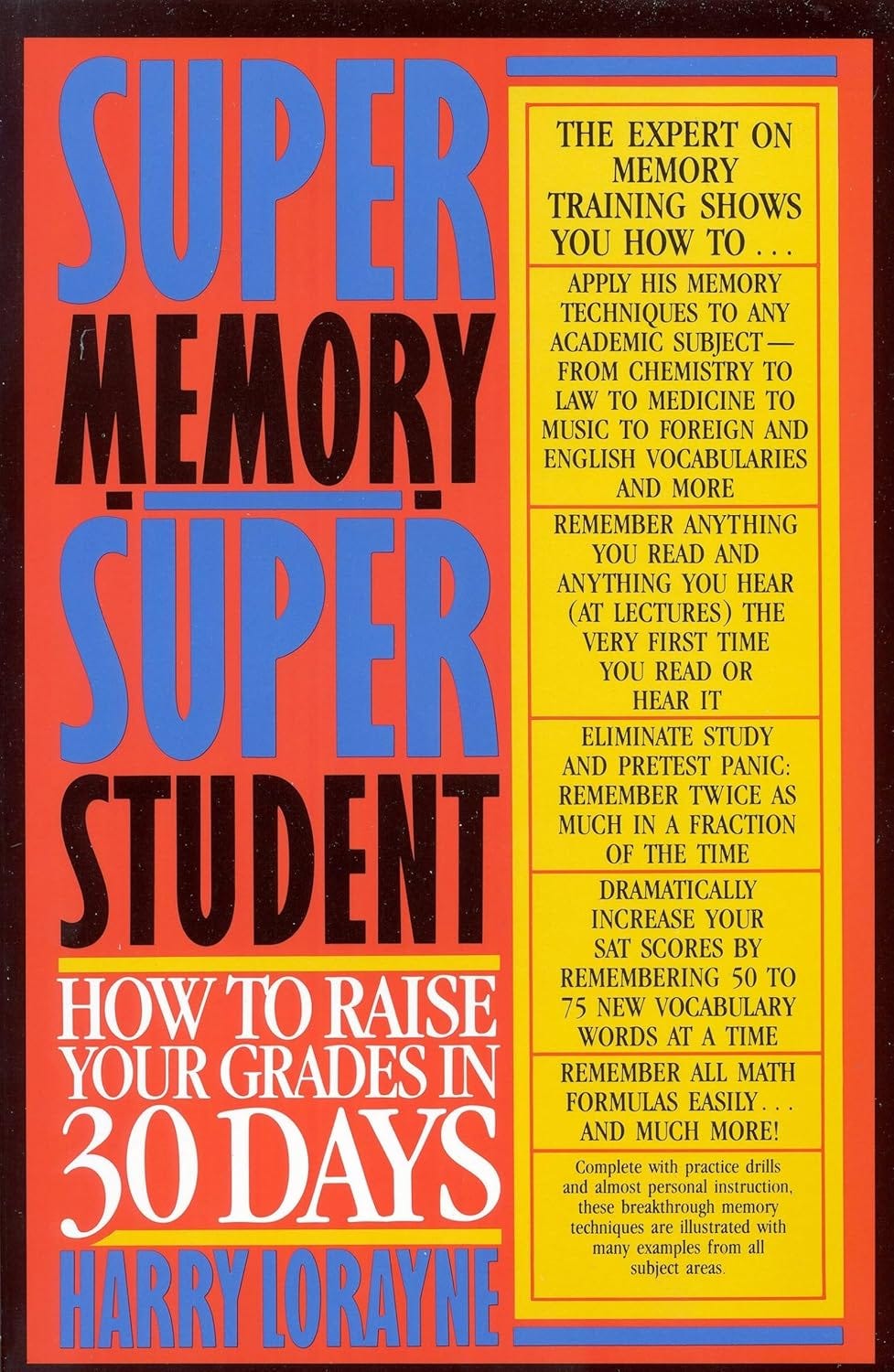
Harry Lorayne has been teaching ancient principles of memorization for 50 years. They really work. My dad taught me these when I was a kid and I still rely on them. At first the methods seem gimmicky, but they soon become habit. The techniques are well proven (some are thousands of years old) and will benefit anyone. However in this book Lorayne aims at students, providing them ways they can use easy tricks to tackle common school memory tasks. He has a system for turning numbers into words so you can remember numbers and dates as well. Imagine how much more efficient you’d be if your memory was just five percent better, and howmuch easier your life would be if everyone else’s improved. —KK
Every high-school student I’ve spoken to knows about the acronym FOIL, which is a memory aid for remembering how to attack an algebraic equation: Firsts, Outers, Inners, Lasts. (More on this in the algebra section in chapter 20.) And I’ve never met a doctor or a medical student who didn’t remember the cranial nerves (olfactory, optic, oculomotor, trochlear, trigeminal, abducens, facial, auditory, glossopharyngeal, vagus, accessory, hypoglossal) by reciting the couplet
On Old Olympia’s Towering Top
A Finn And German Vault And Hop.Professors have helped medical students learn the layers of the scalp by suggesting that the word “scalp” itself might remind them of skin, close connective tissue (cutaneous vessels and nerves), aponeurosis (epicranial), loose connective tissue, pericranium.
I’ve said it so many times, it’s been copied so many times, I may as well say it again: The “three R’s” cliche - reading, ‘riting, ‘rithmetic - should be four R’s. The first R should be remembering. Because without that first R, you can’t read, write, or do ‘rithmetic! All education is based on remembering. I know of no high school or college subject that doesn’t require lots of memory work.
In order for you to remember any new thing it must be associated, in some
ridiculous way, with something you already know or remember.
Desecrate - “to profane a holy place; to treat a sacred thing irreverently”: You’re
in a desert and see a gigantic crate -- desert crate. It’s a sacred thing (perhaps a halo is over it), but you kick it and so forth -- treat it with disrespect, irreverently. (Dat’s a crate would also do.)
Atrophy - “to waste away from lack of use”: A trophy or I throw fee will remind you of the pronunciation. Connect one of them to the meaning of the word. Perhaps visualize a trophy (a gigantic loving cup or statue) wasting away shrinking) because no one ever uses it (see it covered with dust and spiderwebs).
Relegate - “to send to a lower position”: You roll a gate downward, sending it to a lower position. Be sure you actually see that.
Ultimate recovery
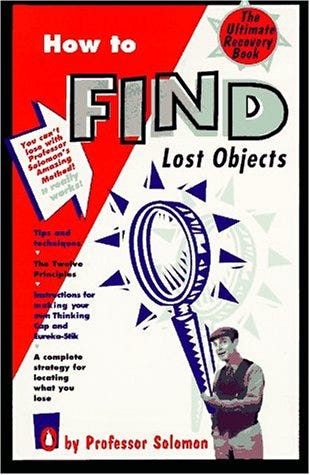
In my household I am Mr. Find It. I rarely if ever lose things myself, and have become the go-to guy to find what others have lost. Over the years of finding things, I have evolved a set of principles very similar to those laid out in this very simple book. This method really works.
You can read this book for free online. That way you’ll never lose it.
But some people like the laminated-paper-pulp form to give as a gift. While there is more in the slim book, none of the extra is essential. Still, it’s a handy quick reference. — KK
Principle Ten
The Eureka Zone
The majority of lost objects are right where you figure-once you take a moment to stop and figure.
Others, however, are in the immediate vicinity of that place. They have undergone a displacement-a shift in location that, although minor, has served to render them invisible.
Some examples:
A pencil has rolled beneath a typewriter.
A tool has been shoved to the rear of a drawer.
A book on a shelf has gotten lodged behind other books.
A folder has been misfiled, several folders away from where it belongs.
Objects are apt to wander. I have found, though, that they tend to travel no more than eighteen inches from their original location. To the circle described by this eighteen-inch radius I have given a name. I call it the Eureka Zone. With the aid of a ruler, determine the Eureka Zone of your lost object. Then explore it. Meticulously.